
Introduction
Smart contract security is a critical aspect of blockchain development. The decentralized and immutable nature of blockchain technology means that any vulnerability in a smart contract can lead to catastrophic consequences, as was the case with Penpie. In this post, we will discuss how mutation testing — a method for validating the effectiveness of test suites — can be employed to prevent such attacks. We’ll also showcase how tools like @Olympix Mutation AI play a vital role in identifying vulnerabilities.
Overview of the Penpie Reentrancy Attack
Before diving into the solution, let’s briefly recap what happened with Penpie. The protocol experienced a reentrancy attack, where a malicious actor exploited the harvestBatchMarketRewards() function. This function, like other functions vulnerable to reentrancy, allowed the attacker to repeatedly call it before the original call was completed, resulting in unauthorized withdrawals of funds.
The absence of reentrancy guards in the code allowed this exploit to occur. While traditional testing techniques might have missed such a subtle vulnerability, mutation testing could have flagged it. Let’s understand how.
What is Mutation Testing?
Mutation testing is a powerful method used to measure the effectiveness of test cases. It involves introducing small, deliberate changes or mutations to the code. These mutations simulate bugs or vulnerabilities that might occur in the contract’s codebase.
The mutated code, known as the mutant, is then tested using the existing test suite. If the test suite fails to catch the change, it indicates that the tests are insufficient, and the coverage is incomplete. This prompts developers to write additional tests or modify the existing ones to catch such issues.
Mutation testing helps ensure that your codebase is well-tested, and critical security measures are in place to prevent attacks like the one on Penpie.
How Mutation Testing Works
1. Apply Mutation: Small changes are made to the smart contract, such as removing a line of code or altering conditions within functions.
2. Run Tests: The mutated contract is then run against the test suite.
3. Evaluate Results:
• If the tests pass despite the mutation, it means that the tests are incomplete. Developers need to write more tests to cover the untested behavior.
• If the tests fail, it indicates that the tests are catching the issue, resulting in a secure contract.
Here’s a visual representation of this process:
This flowchart demonstrates how mutation testing cycles through the contract’s behavior, ensuring that every aspect of the code is validated.
Applying Mutation Testing to Smart Contracts
When applied to smart contracts, mutation testing is particularly effective in identifying vulnerabilities like reentrancy issues. By simulating mutations that alter the behavior of state-changing functions, developers can evaluate whether their contracts are safe under all circumstances.
Example: Testing Deposit Functionality
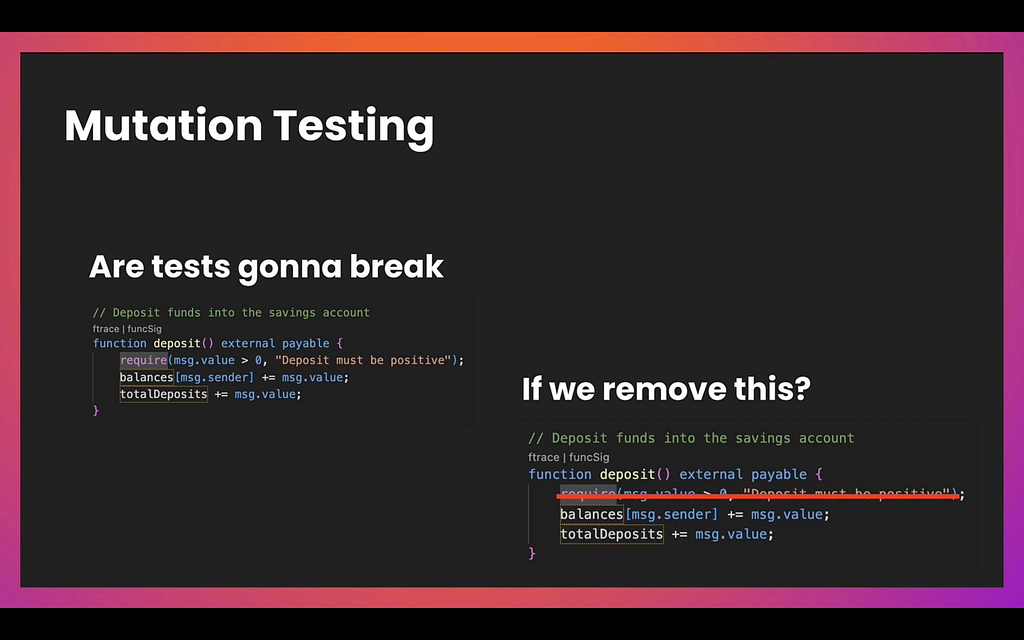
Consider a typical deposit function in a smart contract:
function deposit() external payable {
 require(msg.value > 0, “Deposit must be positive”);
 balances[msg.sender] += msg.value; totalDeposits += msg.value;
}
Now, what happens if the mutation testing tool removes the require statement that checks for a positive deposit value? If the test suite does not detect this change and passes the tests, it indicates that this scenario has not been thoroughly tested.
This image demonstrates how such a mutation might affect the code. If the test suite is unable to detect this removed line, it signifies that more tests are needed to cover this aspect.
The Role of @Olympix Mutation AI Tool
To make mutation testing more effective, tools like @Olympix Mutation AI provide an automated and in-depth analysis of smart contracts. The Olympix tool:
• Applies a variety of mutations automatically to simulate potential vulnerabilities.
• Runs the mutated versions of the contracts against the test suite to evaluate coverage.
• Highlights areas where tests failed to catch the mutation, guiding developers to enhance the test cases.
Incorporating @Olympix Mutation AI in the testing process helps developers catch edge cases and vulnerabilities like the reentrancy issue that impacted Penpie. With its robust analysis, developers can ensure that their contracts are resistant to common and complex exploits.
Conclusion: Strengthening Security with Mutation Testing
The Penpie incident underscores the importance of rigorous testing in smart contract development. By integrating mutation testing into the development cycle, blockchain developers can significantly improve the security of their smart contracts. Tools like @Olympix Mutation AI enable developers to simulate a wide range of vulnerabilities, ensuring that even the most subtle bugs are caught and mitigated.
Key Takeaways:
• Mutation testing is essential for validating the completeness and effectiveness of your test suite.
• Reentrancy attacks and other subtle vulnerabilities can be caught early through this method.
• Tools like @Olympix Mutation AI automate this process, making it easier to identify and fix security issues before they become exploit targets.
Mutation testing is not just a good-to-have but a must-have practice for every blockchain developer aiming to build robust and secure smart contracts.